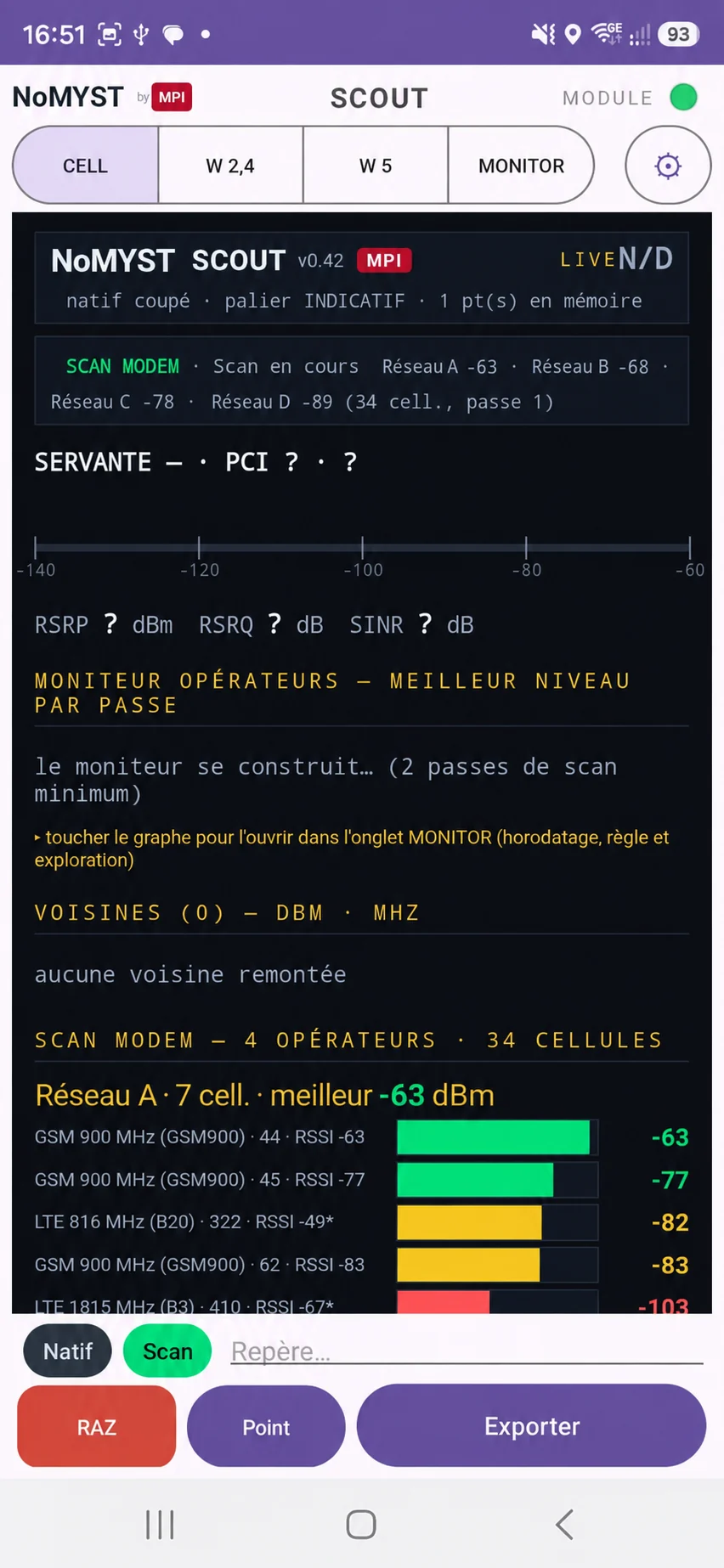
A single scan photographs an instant. It sees the cells that were transmitting at that moment, from that angle, with that traffic. On a real site, a single pass revealed only 9 cells where twenty passes found 21. Repeatability is not a refinement: it is the measurement.
A cell seen once
Mobile networks are not static. A cell may be audible only at certain moments, by reflection off a vehicle, during a lull in traffic, or because the technician's hand moved. A scan that sees it once is not wrong; it simply has not proved the cell is usable.
Conversely, a cell absent from one pass is not necessarily absent from the site. That is why Scout never concludes “no coverage” on a single pass.
The seen X/N counter
On each pass, Scout sweeps the bands and notes the detected cells. The “seen X/N” counter shows, for each cell, the number of passes in which it was found over the number of passes made. Seen 20/20: stable presence. Seen 3/20: episodic appearance. Seen 1/20: an event.
This counter is the first column to read. Level comes next: a high level on an episodic cell is a classic trap when choosing a location.
The example: 9 cells in one pass, 21 in twenty
During a 5G multi-network sweep on an anonymised site, the first pass listed 9 distinct cells. After twenty passes, Scout counted 21. The five most stable (bands B1, B8, B20, B28) were seen between 15 and 20 times out of 20; the others only a few times.
Without multi-pass, the technician would have chosen among 9 candidates, several of them episodic. With it, the choice is among those that proved their presence.
How many passes are needed?
Five passes are enough to separate stable from episodic at a fixed point. Twenty passes give a robust picture of a router or charger location. A walking continuity campaign chains passes from point to point; the route sets the number.
The right question is not “how many passes?” but “has the list stopped changing?”. When two more passes add no new cell, the measurement has stabilised.
What multi-pass does not fix
Repeating a measurement fixes neither the equipment nor the time of day. A module that does not listen to a band will never see it, however many passes. A site measured at 2 pm on a Sunday says nothing about Monday-morning saturation.
Scout documents the equipment, the number of passes, the bands observed and the conditions, so that the reach of the conclusion stays verifiable.
A NoMYST example