NoMYST Pulse · Link quality

Voice reveals what throughput conceals.

Pulse stimulates, observes and explains the defects that impair voice, video calls and real-time traffic — even when a speed test looks reassuring.

NoMYST Pulse is an Android app that measures the real quality of a link for voice and video: latency, jitter, loss and micro-outages, before and during load, with a probable cause.

Get NoMYST PulseAvailable on Google Play in early access: write to us to receive the installation link. iOS and PC versions in preparation.
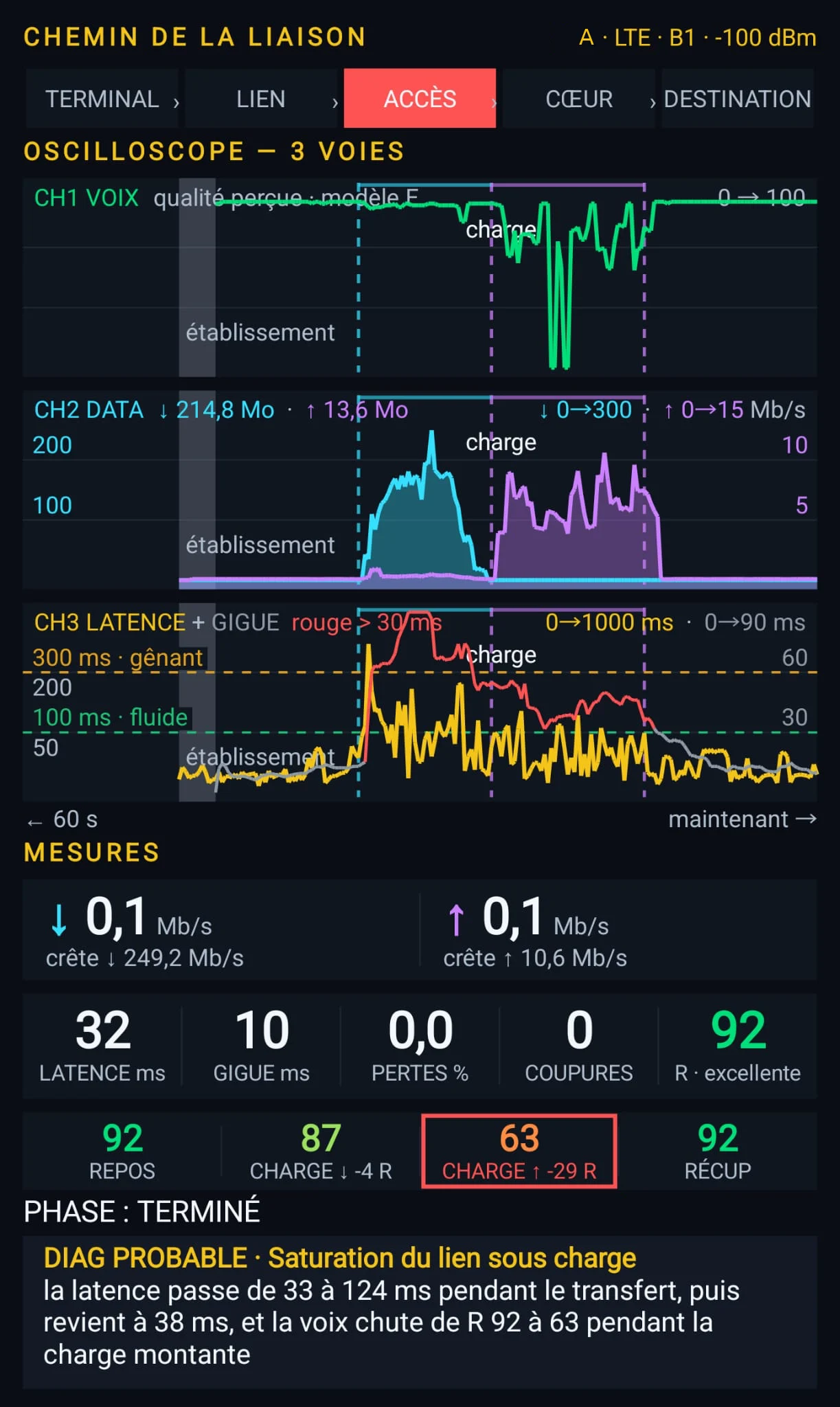
NoMYST Pulse: voice, download and upload throughput, latency and jitter on three synchronised charts; carrier anonymised
Pulse screenshot · carrier anonymised · tap to enlarge
NoMYST Pulse · real measurement

Three charts. One connection.

Voice quality, throughput and latency share the same timeline. Here, voice holds up during the download load (R 87), then drops to R 63 as soon as the phone starts sending: the uplink is what saturates.

  • CH1 · VoiceThe perceived quality score (E-model), from 0 to 100.
  • CH2 · DataDownload throughput in cyan, upload in purple, each on its own scale.
  • CH3 · Latency + jitterLatency rises past the 100 ms (smooth) and 300 ms (disruptive) thresholds; jitter turns red above 30 ms.

The summary scores each phase (idle, download load, upload load, recovery) and counts dropouts. Here Pulse concludes the link saturates under load: the charts show the symptom and when it appears; the diagnosis guides the next check.

What Pulse measures

  • Round-trip latency and how it evolves throughout the test.
  • Jitter — the inconsistency of packet arrival times.
  • Loss, its frequency and whether it is isolated or clustered.
  • Dropouts and micro-outages, counted and timed, too short to show in a simple bar graph.
  • Throughput under load, download and upload, without confusing it with conversation quality.

A cycle designed to find the cause

  • Idle phase: observe the link before stressing it.
  • Load ramp: detect quality changes as traffic appears.
  • Established load: measure consistency over time.
  • Return to idle: verify whether the link recovers its initial state.

A useful conclusion

Pulse does more than display charts. It relates symptoms to the moment they appear. High jitter at idle does not tell the same story as deterioration caused only by load.

The report separates observations, likely origin and verification steps. When the evidence is insufficient, it says so explicitly.

What Pulse does not claim to do

Pulse characterises a data link and its suitability for real-time uses. It does not replace carrier certification, external radio measurement or acoustic analysis of the handset.

Who it is for, and when

  • IT team rolling out VoIP or video callsCheck before the switch-over that the link holds a conversation, not just the advertised throughput.
  • Installer of a voice gateway on 4GQualify the mobile link at the installation point: loss at rest, behaviour under load, return to normal.
  • Support desk facing “it keeps cutting out”Reproduce the fault in four phases and get a lead: saturation, radio instability, local interferer.
  • Technician who has just fixed a faultRun the same measurement after the intervention and keep a shareable before/after.

What Pulse replaces, and what it does not

Compared with…What Pulse bringsWhat the other tool keeps
A speed testPulse measures what makes a good conversation: regularity, loss, micro-outages, and how those values move when traffic appears. 503 Mbps with a voice score of 52/100 is a real Pulse result.The speed test remains useful to check a subscription or raw capacity.
A pingPing gives an average latency. Pulse reads it over time, with its jitter, on three synchronised charts, alongside the perceived voice quality.A one-off ping is enough to know whether a host answers.
A monitoring probePulse starts in seconds where the problem is reported, with nothing to install or host at the customer's site.A permanent probe remains the right tool to watch a link around the clock and raise alerts.

Frequently asked questions about Pulse

Why 503 Mbps and a voice score of 52/100 on the same measurement?

Because throughput and conversation do not depend on the same things. During the transfer, latency became very irregular and voice quality collapsed: the link had capacity, but no regularity.

What does the four-phase cycle measure?

Rest: the link before any load. Ramp-up: does quality degrade when traffic appears? Sustained load: stability over time. Back to rest: does the link return to its initial state?

Which server does Pulse send its test traffic to?

To the NoMYST echo server (echo.nomyst.com), operated by MPI in France, or to a measurement server you designate. Test packets contain no personal data.

Does Pulse work on Wi-Fi and wired links?

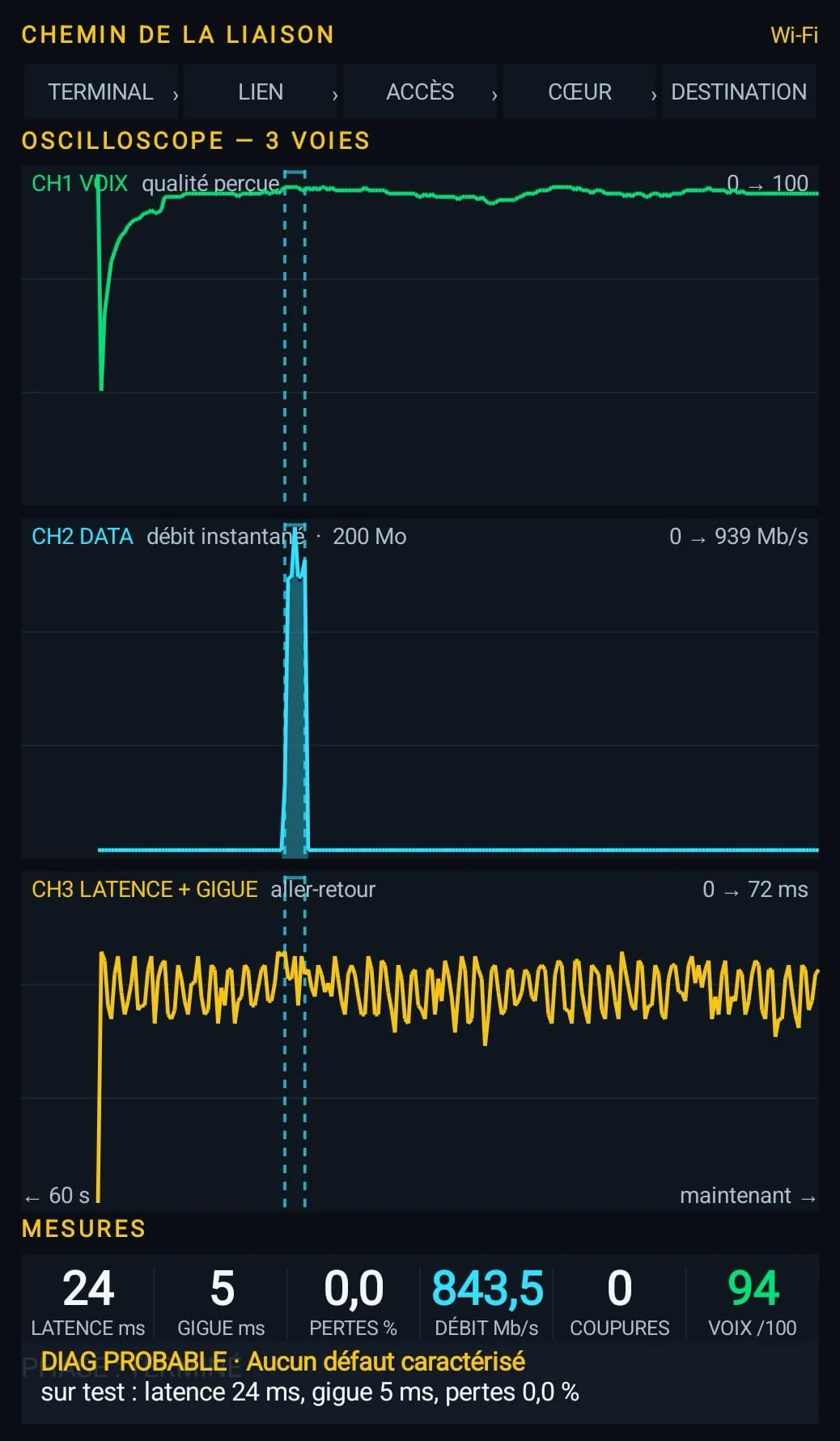
Yes. Pulse measures the link the phone is using: mobile network, Wi-Fi, or Ethernet through a USB adapter. That is how it verifies a local network after an intervention.

Is the voice score a MOS?

It is a perceived-quality score computed from latency, jitter and loss, in the spirit of the ITU-T G.107 E-model. It is comparable from one Pulse measurement to the next; it is not a standardised subjective measurement.