The RRF (Réseau Radio du Futur) is the mobile network of France's emergency and security services. Its continuity in public-access buildings, car parks and basements conditions how the emergency services can operate. Measuring before the works avoids sizing blind; measuring after verifies that the expected continuity is achieved.
What the RRF is and who is concerned
The RRF relies on the carriers' 4G/5G mobile networks, with priorities and mechanisms specific to State services. For a building operator, the practical question is simple: will the emergency services' devices have a link in the corridors, the underground levels, the plant rooms?
Concerned first are large public-access buildings, covered car parks, tunnels and sites where the emergency services must be able to communicate at every point. The exact obligations follow the regulations applicable to each type of establishment.
Why measure before the works
Without a prior measurement, the indoor coverage solution is sized on assumptions: number of antennas, positions, sources. A pre-diagnosis locates the weak and the compliant areas, which reduces the installation to what is necessary.
The measurement before the works also serves as a reference: it is what will make it possible to prove the improvement after installation, point by point.
What a point-by-point campaign shows
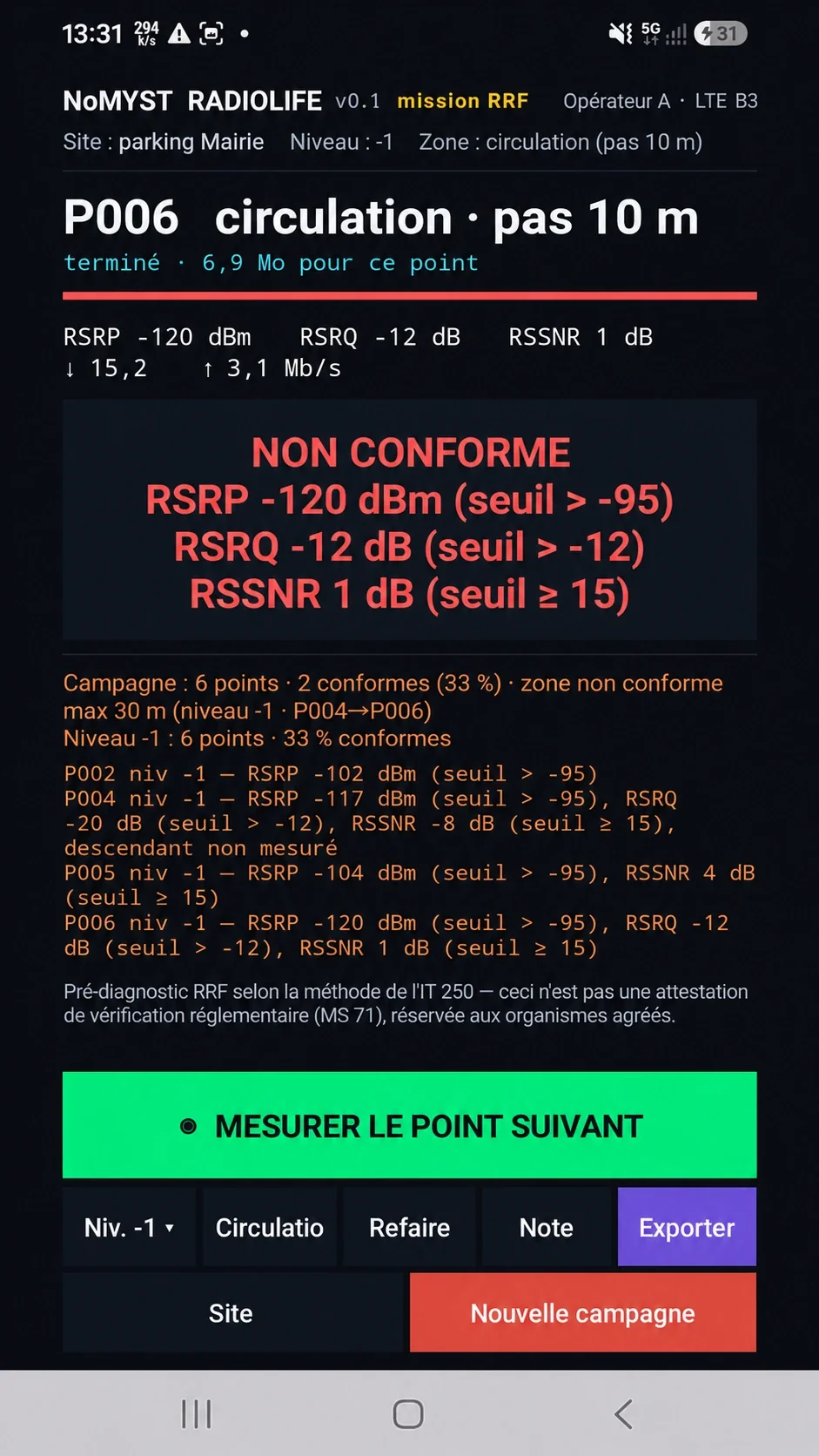
In the campaign published on this site, reference point P001 measured −75 dBm, satisfactory quality. At point P003, the current point was still compliant but the history already flagged a non-compliant area behind it. P005 confirmed the degradation at −104 dBm, and P006, at −120 dBm, marked a 30 m non-compliant area along the route.
The result builds up while walking: each measurement keeps its context, the previous points and the extent of the area concerned. At the end of the route, the map of weak areas already exists.
Pre-diagnosis and certification: two different things
A pre-diagnosis is a documented finding, with its thresholds, its equipment and its conditions. It locates the fault, prepares the solution and verifies the result. A regulatory certificate follows a defined procedure, with recognised means and actors.
Mission provides the first and prepares the second. A NoMYST report says so explicitly, and states what requires a specific procedure.
How Mission fits into a project
Before: a pre-diagnosis campaign along the useful routes, thresholds set with the owner. During: comparison of candidate source and antenna positions, following the level in real time. After: same route, same thresholds, to verify the continuity achieved and document the before/after.
The same protocol applies to lone-worker protection and to EV-charging connectivity, where radio continuity conditions safety or service.
A NoMYST example