RRF campaign in a basement: continuity loss point by point, from −75 to −120 dBm
By the NoMYST team, MPI · Published 18 September 2026
In a public-access building, a pre-diagnosis route starts from a compliant reference point at −75 dBm and documents, point after point, a non-compliant area that reaches 30 m at −120 dBm. The result exists at the end of the walk; it prepares the solution and is not a certificate.
Context
The building is a public-access establishment with underground levels. The measured carrier is replaced by “Carrier A” and no precise location is published. The thresholds for this campaign were set with the owner; −104 dBm marks insufficient quality.
The route follows the corridors the emergency services would use. Each point keeps its number, its level, the history of previous points and the extent of the area concerned.
Measurements
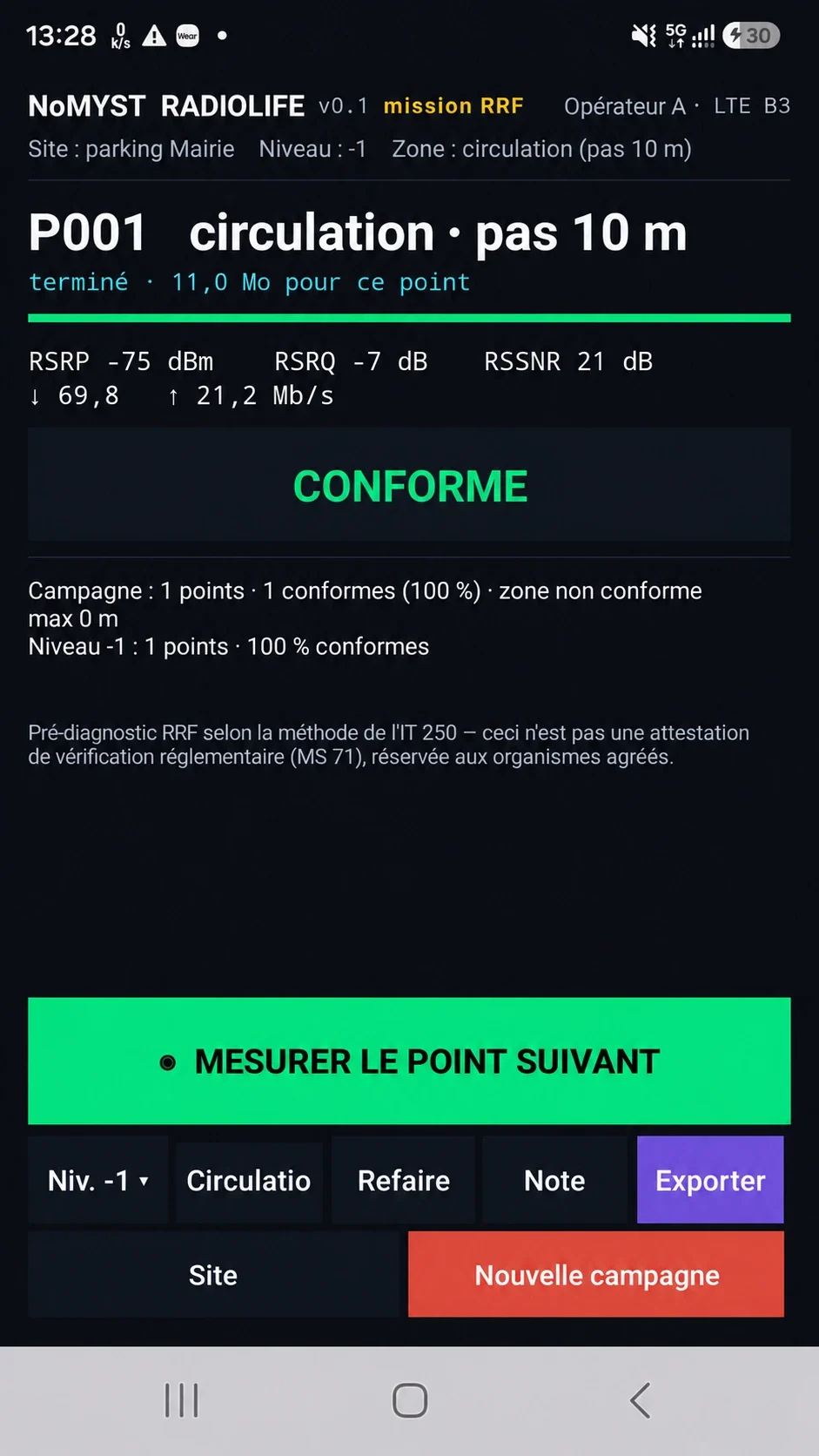
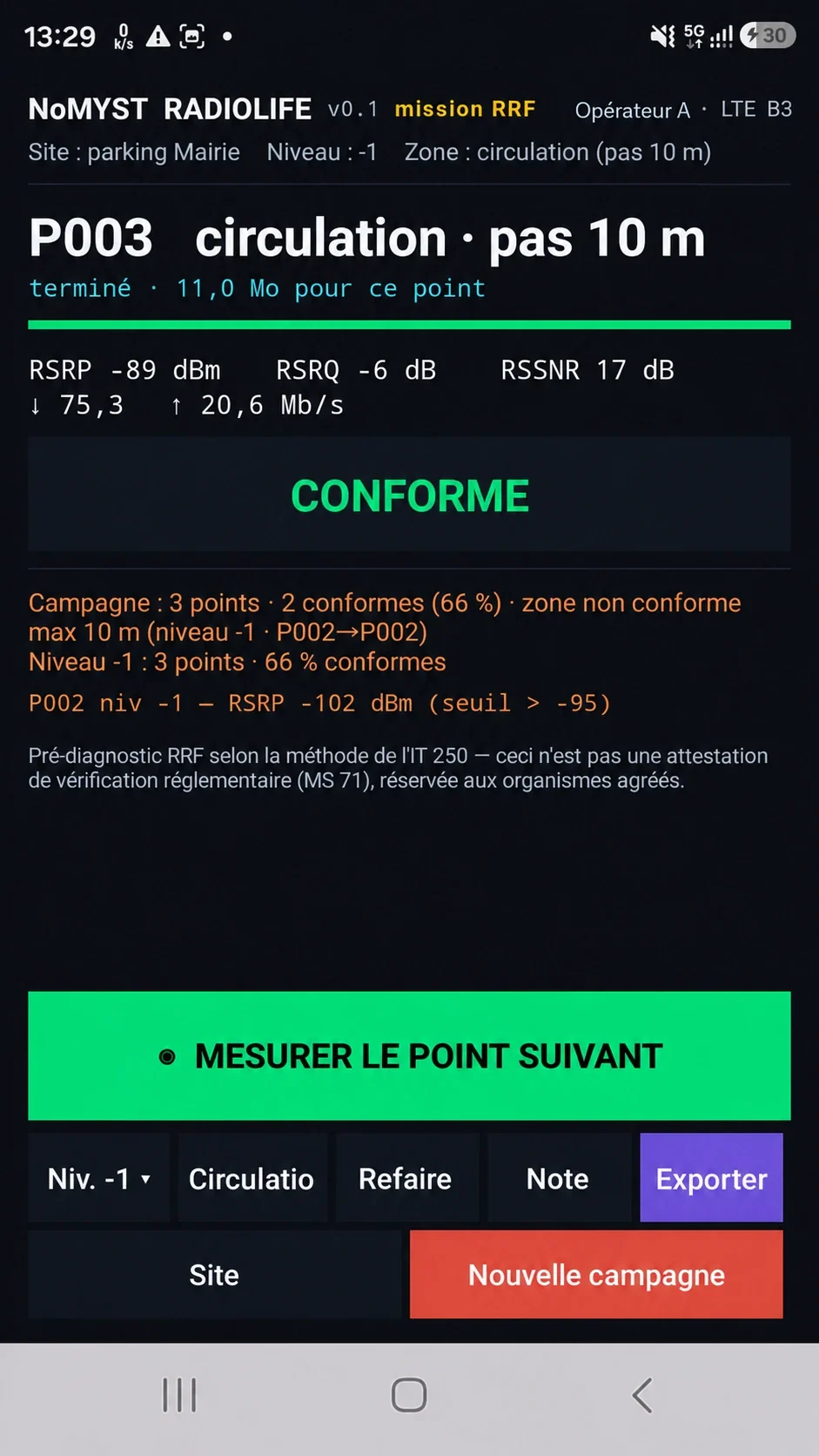
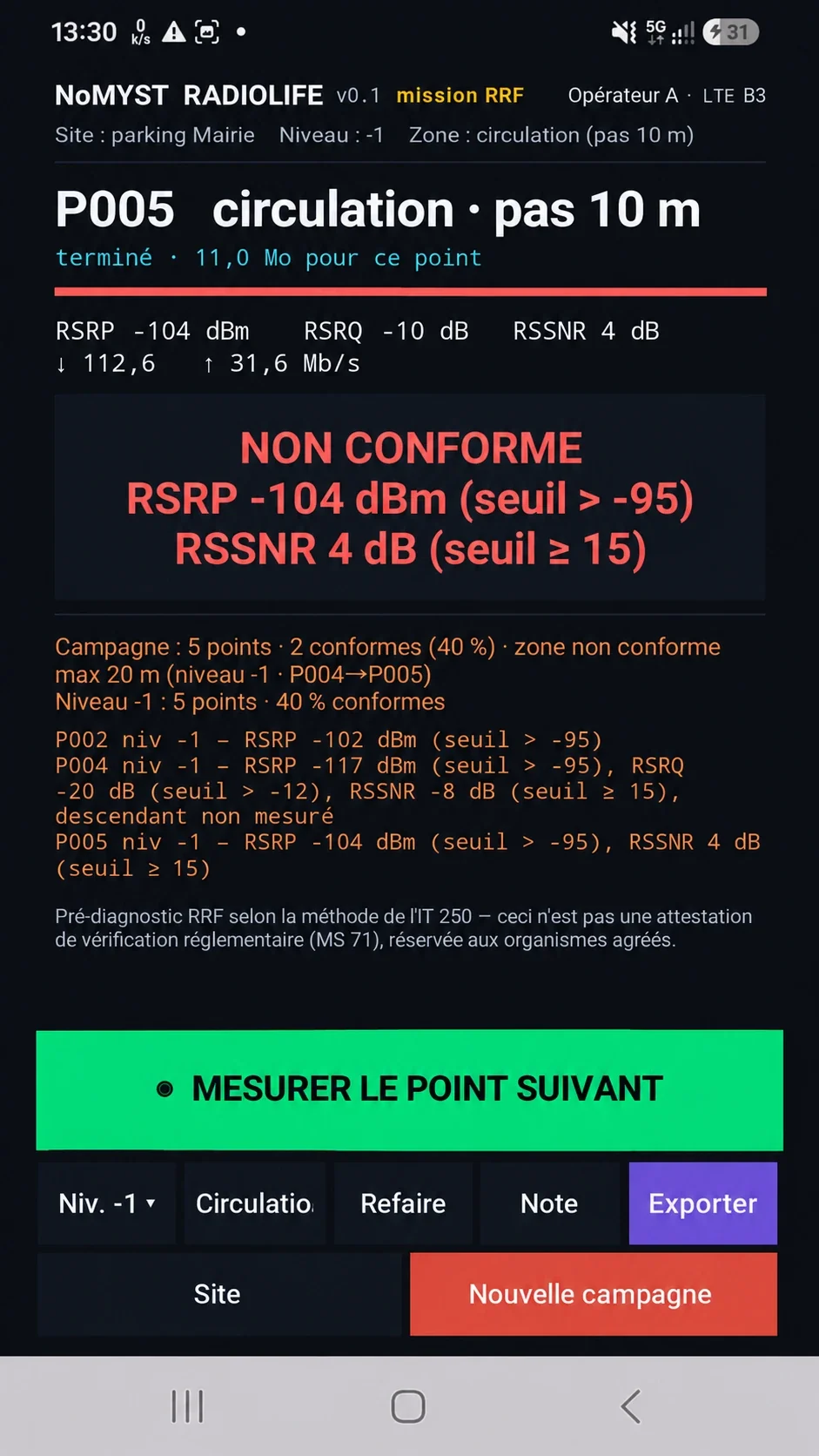
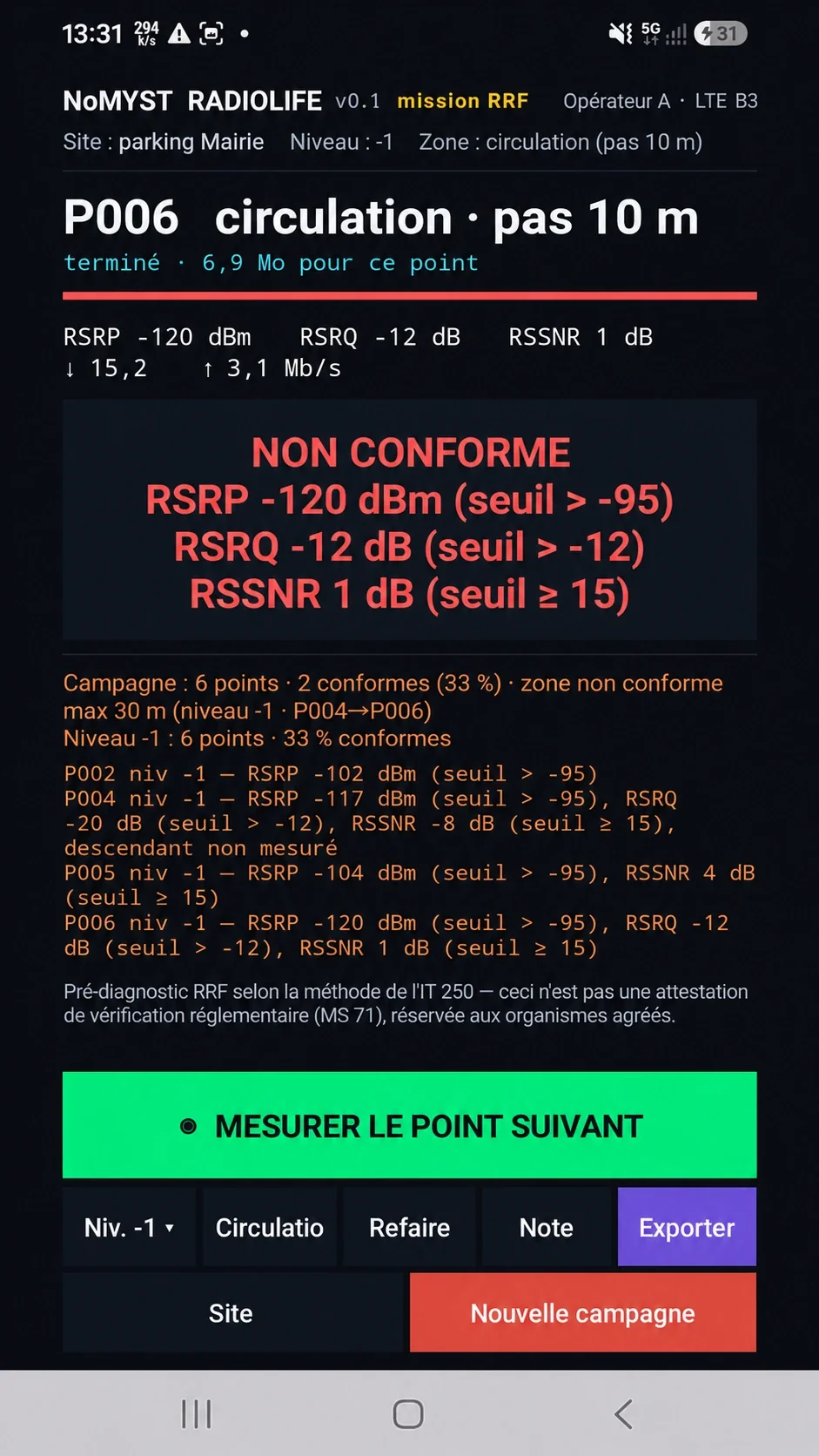
P001 · Compliant reference point−75 dBm: satisfactory radio quality at the start of the route. This is the reference the following points are compared with.P003 · The campaign reveals a breakThe current point is still compliant, but the history already flags a non-compliant area between P001 and P003. The campaign sees the break before the technician feels it.P005 · Degradation confirmed−104 dBm: insufficient quality according to the thresholds set for this campaign. The non-compliant area extends.P006 · Degraded area extends−120 dBm: the non-compliant area reaches 30 m along the measured route. The map of the weak area is established at the end of the walk.
−75 dBmreference point P001
−104 dBminsufficient-quality threshold
−120 dBmlevel at point P006
30 mextent of the non-compliant area
Reading
The result builds up while walking. It is not a matter of taking points and then waiting for an analysis: at each point, the technician sees the level, the history and the extent of the area concerned. The next steps, comparing source positions and then verifying after installation, start from that same route.
This campaign illustrates a field pre-diagnosis. It helps locate the fault, prepare a solution and verify its result.
What this case does not prove
This finding is not a regulatory certificate. It holds for the measured carrier, the equipment used, the route followed and the thresholds chosen, on the date of the campaign.